The Regional Pulse: Beyond the Macro-Economic Narrative
While the first three pillars of our strategy focus on broad institutional health and workforce shifts, Regional Commentary provides the granular, localized intelligence necessary for operational success in the Mid-Atlantic corridor. In 2026, the economic distance between Northern Virginia, Baltimore, and Washington, D.C., has never been shorter in terms of digital connectivity, yet the legislative and operational hurdles within each remain distinctively unique.
Effective leadership in this environment requires more than a regional overview; it demands a “boots on the ground” understanding of how a single municipal ordinance in NoVa or a transit shift in Baltimore can disrupt a multi-state supply chain or a federal contracting vehicle.
I. Northern Virginia (NoVa): The Data Sovereign Frontier
Northern Virginia continues to host the world’s largest concentration of data centers, but the “Gold Rush” era of unchecked expansion has transitioned into a highly regulated period of Data Sovereignty and Energy Stewardship.
- The 2026 Legislative Pivot: Virginia lawmakers have introduced over 60 bills this year aimed at regulating data center growth. New mandates now shift energy infrastructure costs directly to high-demand users those consuming 25 MW or more preventing these costs from being passed on to residential ratepayers.
- Siting and Sound Restrictions: For the first time, facilities using 100 MW or more are subject to rigorous sound assessments and must maintain significant setbacks from residential areas and schools.
- Economic Impact: While tax exemptions remain a point of fierce debate in Richmond, the 2026 environment prioritizes “Demand Flexibility”. Organizations operating in NoVa must now integrate clean power and water-usage reporting into their primary permitting processes to maintain their social and operational license to operate.
II. The Baltimore Metropolitan Area: Logistics and Urban Resilience
In Baltimore, the 2026 narrative is defined by the revitalization of port-based logistics and a strategic shift toward Urban Manufacturing Hubs.
- Port Access and Industrial Real Estate: Following record-setting activity in late 2025, the Port of Baltimore remains the primary engine for regional distribution. Demand for industrial space along the I-95 North corridor has surged, with a “flight to quality” favoring modern facilities with clear heights exceeding 24 feet.
- Transformational Infrastructure: The Greater Baltimore Committee’s 2026 priorities include the “Downtown RISE” master plan and the Sparrows Point container terminal expansion. These initiatives are designed to anchor the region as a global logistics leader while addressing long-term workforce shortages in the trades.
- Municipal Shifts: Baltimore City is increasingly utilizing Tax Increment Financing (TIF) and transit-oriented development such as the Bowie State MARC Station project to stimulate mixed-use growth and multi-modal connectivity.
III. The District of Columbia: Rebranding the Core
Washington, D.C., is currently navigating a period of fiscal rightsizing as it responds to a permanent shift in federal workforce presence.
- The “Grow DC” Agenda: Mayor Bowser’s FY2026 budget focuses on a proactive growth strategy to offset the projected loss of 40,000 federal-related jobs. The city is aggressively cutting red tape, pausing Building Energy Performance Standards, and reforming zoning to attract private sector investment.
- The Service Economy Evolution: With the federal presence shrinking, D.C. is pivoting toward a more diverse economic base. This includes expanding retail grant programs and eliminating sales tax increases to stabilize the local restaurant and service sectors. Underpinning this revitalization is a commitment to digital integrity; as the city diversifies, it is critical to ensure that the data generated by inbound logistics and the mobile workforce is processed securely, supporting the Zero-Trust architectures identified in our Institutional Analysis.”
IV. Legislative Impacts: Navigating the 2026 Regulatory Patchwork
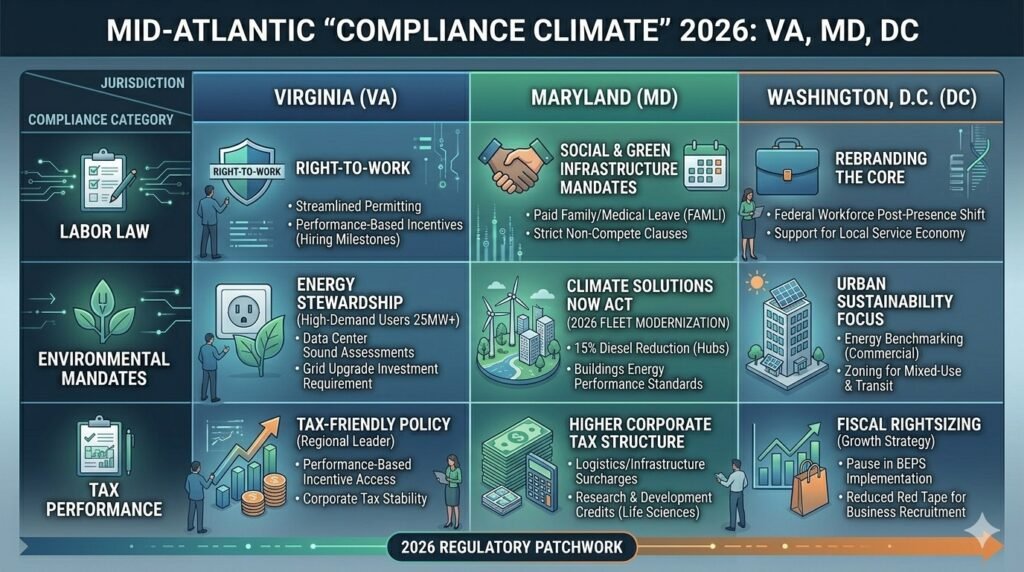
The Mid-Atlantic is currently defined by a “Tale of Three Jurisdictions.” While the physical borders between DC, Maryland, and Virginia are seamless, the legislative divergence has reached a critical peak. Organizations operating across these lines must now manage three distinct sets of compliance mandates.
1. The Virginia Corporate Pivot
Virginia continues to lean into a pro-growth, “open-for-business” stance, but with new 2026 caveats regarding environmental and labor oversight.
- The Regulatory Shift: Recent sessions in Richmond have prioritized the “VPP” (Virginia Property Protection) updates, which streamline the permitting process for industrial sites but mandate stricter disclosures on water usage for tech facilities.
- Tax Incentives: While Virginia remains the regional leader in tax-friendly policy, the 2026 budget has pivoted toward “Performance-Based Incentives.” Firms only receive full exemptions if they meet specific 2026 hiring milestones specifically targeting the “underemployed” brackets of the NoVa workforce.
2. Maryland’s Social and Green Infrastructure Mandates
Maryland’s 2026 legislative session has doubled down on its commitment to the “Climate Solutions Now” Act, creating immediate operational requirements for regional businesses.
- Carbon-Neutral Logistics: Any organization utilizing heavy logistics hubs in the Baltimore-Washington corridor is now subject to the 2026 Fleet Modernization mandate. This requires a 15% reduction in total diesel-based transport usage for firms with gross revenues over $50M.
- Paid Leave and Labor Protections: Maryland is currently rolling out the full implementation of the Family and Medical Leave Insurance (FAMLI) program. For institutional leaders, this means navigating a more complex payroll and compliance landscape than their neighbors in Virginia.
V. Municipal Policy Shifts: Local Governance as a Business Variable
Beyond the state level, 2026 has seen an unprecedented rise in “Municipal Activism,” where specific counties and cities are setting the pace for regional economic policy.
1. Montgomery County’s “Economic Development 2.0”
Recognizing the competition from NoVa, Montgomery County has launched a 2026 initiative to fast-track “Speed-to-Market” for life sciences.
- Zoning Reform: New “Bio-Zoning” laws allow for existing office inventory to be converted to BSL-2 and BSL-3 laboratory space with minimal public hearing requirements.
- The IMPACT: This has successfully lowered the commercial vacancy rate by 8% in the first quarter of 2026, though it has created a temporary strain on the local power grid.
2. Arlington and Alexandria: The “Crystal City” Post-Retail Era
With the stabilization of HQ2 and the surrounding innovation district, these municipalities are shifting their focus to workforce housing.
- Legislative Lever: The 2026 “Missing Middle” housing policies are being aggressively defended in court, as the regionrealizes that without affordable housing for the service and entry-level tech workforce, the Executive Suite & Leadership Strategy becomes unsustainable.
- Transportation Integration: The expansion of the “Bus Rapid Transit” (BRT) lanes across the Potomac is now a top-tier business priority, as firms recognize that regional labor mobility is their greatest competitive advantage.
VI. Regional Connectivity: The Infrastructure Backbone
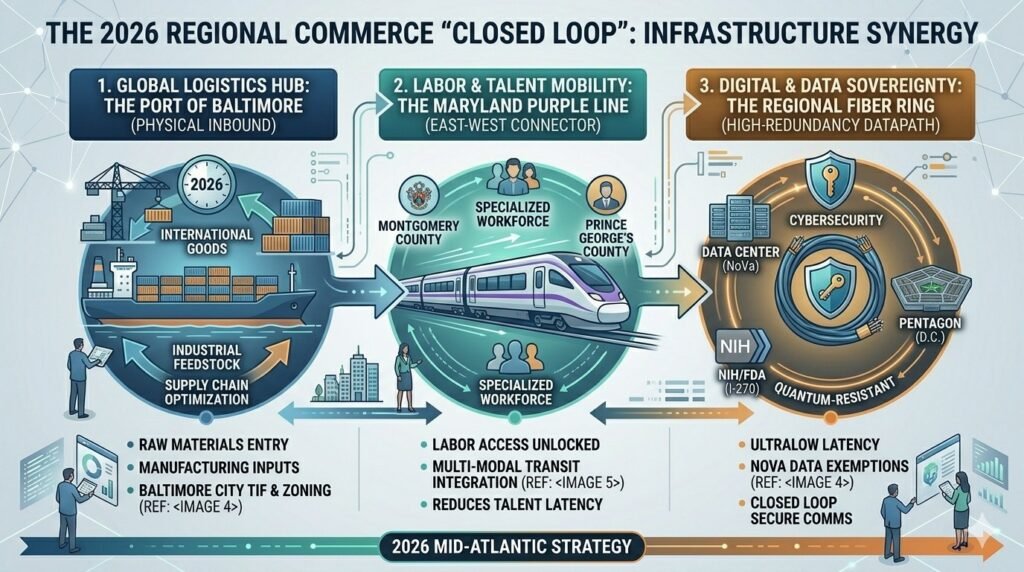
In 2026, we are witnessing the completion of the “Digital and Physical Loop” a series of infrastructure projects that finally unify the corridor.
- The Purple Line Impact: As Maryland’s Purple Line reaches full operational status in 2026, we are seeing a massive shift in talent recruitment. Job seekers in Prince George’s County are now accessing opportunities in Bethesda and Silver Spring that were previously geographically “locked” by the lack of east-west transit.
- Terrestrial Fiber Expansion: A massive public-private partnership (P3) has completed the 2026 “Corridor-Wide Fiber Ring,” providing high-redundancy, ultra-low latency connections between Baltimore’s port systems and NoVa’s data clusters.
VII. The 2026 Economic Resilience Outlook
As we look toward the final quarters of 2026, the Mid-Atlantic’s ability to remain an economic powerhouse depends on its capacity for Inter-Jurisdictional Cooperation. The “siloed” approach of the early 2020s where Maryland, Virginia, and DC competed aggressively for the same pool of resources is being replaced by a model of shared regional resilience.
- The Talent Mobility Index: 2026 data indicates that the highest-performing firms are those that treat the DMV as a single labor market. By leveraging the physical connectivity of the Purple Line and the digital connectivity of the Corridor-Wide Fiber Ring, these organizations have expanded their talent reach by 25% a critical evolution of the concepts found in our Mid-Atlantic Workforce Strategy.
- Energy and Water Sovereignty: The regional commentary for late 2026 highlights a shift in “Corporate Citizenship.” In NoVa particularly, the ability to secure power for data operations is now tied to a firm’s investment in local grid upgrades. We expect this “Resource-for-Access” model to become the standard for high-density industrial development across the corridor.

VIII. Municipal Risks and Monitoring Points
While the outlook is generally positive, three specific “Regional Friction Points” require constant monitoring by C-Suite leaders:
- D.C. Fiscal Rightsizing: Watch for potential service cuts or specialized business fees if the “Grow DC” agenda does not meet revenue targets by Q4.
- Baltimore’s Labor Pipeline: The Sparrows Point expansion is hungry for skilled trades; any delay in vocational training throughput will create a bottleneck in regional logistics.
- The “Green-Tape” Ceiling: In Maryland, ensure that operational scaling plans account for the 2026 Fleet Modernization milestones to avoid significant compliance penalties.
IX. Conclusion: The Power of Proximity
In 2026, the Mid-Atlantic corridor remains one of the most complex yet rewarding business environments in the world. The proximity to federal power, the density of specialized scientific talent, and the world-class logistics of the Port of Baltimore create a unique “Stability Engine.”
However, as Regional Commentary illustrates, this stability is not a given it is managed at the municipal level. Success in this region requires a dual-focus: an eye on the macro-trends of Pillar 1 and 2, and a foot on the ground in the neighborhoods, council chambers, and utility commissions of the DMV. By synthesizing these perspectives, organizations can navigate the legislative patchwork and infrastructure shifts to claim their place in the 2026 economy.
The team at SCBWI Mid-Atlantic remains dedicated to monitoring these municipal friction points