The role of the Mid-Atlantic executive in 2026 has transitioned from the stewardship of resources to the governance of systems. As we navigate the midpoint of the decade, the region’s C-suite is no longer defined by “Command and Control” hierarchies but by the ability to orchestrate a complex, hybridized workforce where human intuition and algorithmic precision coexist. Within this Executive Suite & Leadership Strategy, the Mid-Atlantic Professional Review defines this shift as the “Mandate of Systemic Oversight.”
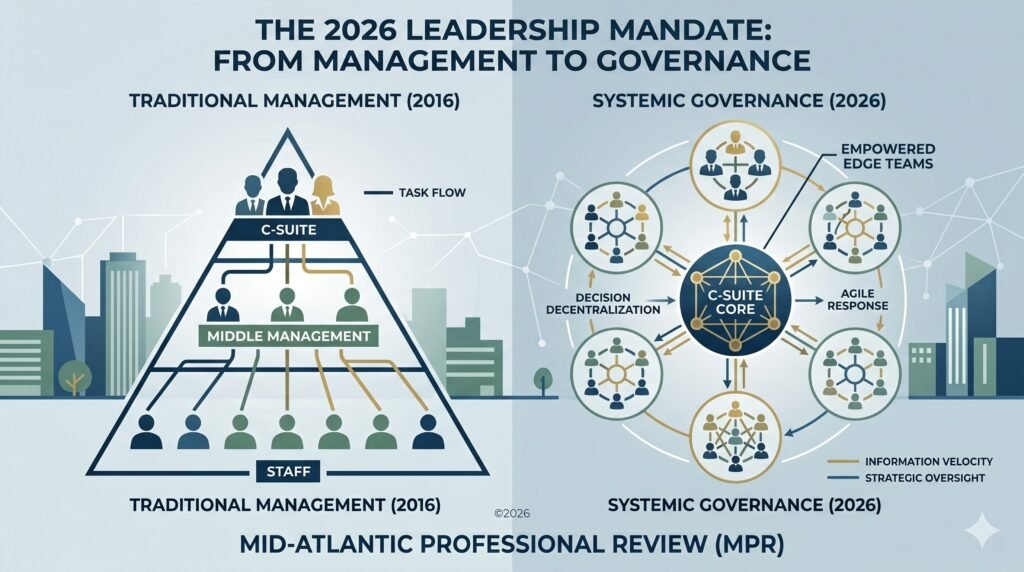
I. The 2026 Leadership Mandate: From Management to Governance
In the previous decade, leadership was largely a function of tactical management optimizing workflows, managing headcounts, and ensuring quarterly compliance. However, the dual pressures of federal sector realignment and the total integration of AI have rendered tactical management obsolete.
Modern leaders must now act as Institutional Architects. This requires a fundamental pivot in three key areas:
1. The Dissolution of Traditional Hierarchies
The Mid-Atlantic corridor, long known for its rigid, bureaucratic structures in defense and government contracting, is witnessing a “flattening.” AI agents now handle the bulk of middle-management reporting, which has removed the traditional “buffer” between the C-suite and front-line operations.
- The Governance Shift: Leaders must now be comfortable with Decentralized Decision-Making.
- The Impact: By empowering “edge” teams with real-time data, executives can increase institutional velocity while maintaining strategic alignment.
2. Algorithmic Accountability
In 2026, the board of directors is legally and ethically responsible for the “behavior” of the organization’s AI. This is no longer a technical concern for the CTO alone; it is a core governance requirement for the CEO and COO.
- Trust as a KPI: Organizations that cannot prove the “Explainability” of their AI decisions are facing significant reputational and legal risks in the DC and Maryland courts.
- Ethical Guardrails: Leadership strategy now involves the creation of AI Ethics Committees that report directly to the board, ensuring that automated efficiency does not come at the cost of institutional integrity.
3. The “Human Premium” in a Digital Age
As technical tasks are automated, the value of uniquely human traits empathy, complex negotiation, and moral reasoning has reached an all-time high. This is the “Human Premium.”
- Strategic Empathy: 2026 leaders are evaluated on their ability to maintain Psychosocial Safety. In a high-pressure environment like the Mid-Atlantic, the ability to retain top talent through a culture of trust is the ultimate competitive advantage.
- Cultural Stewardship: The C-suite must ensure that the “soul” of the institution remains intact even as the digital “body” of the company evolves.
II. Strategic Resilience in a Volatile Corridor
Regional executives are currently operating in a “Low-Hire, Low-Fire” environment, which requires a specific brand of fiscal and operational resilience. Unlike previous cycles where “mass layoffs” were the standard response to headwinds, 2026 strategy favors Modular Scalability
By building organizations that can scale human and digital capacity independently, Mid-Atlantic leaders are ensuring that their institutions remain agile enough to survive federal contract shifts without losing their most valuable intellectual capital.
II. Algorithmic Governance & The New C-Suite Roles
As the mandate shifts from management to governance, the traditional C-suite structure is undergoing a radical transformation. In 2026, institutional excellence in the Mid-Atlantic corridor is defined by how well an organization integrates automated intelligence into its core leadership functions. This has given rise to the “Governance Triad,” a reconfiguration of executive responsibilities designed to manage the intersection of human talent and algorithmic output.
1. The Chief AI Governance Officer (CAIGO)
The most significant addition to the 2026 executive suite is the CAIGO. Unlike the CTO, who focuses on infrastructure, the CAIGO is responsible for the ethical and legal integrity of the institution’s autonomous systems.
- The Audit Mandate: In Maryland and Virginia, new regulatory frameworks now require biannual audits of AI decisioning in hiring and procurement. The CAIGO oversees these audits to ensure “Explainability” the ability to trace an AI’s decision back to a non-biased logic path.
- Liability Mitigation: By establishing “Human-in-the-Loop” (HITL) checkpoints, the CAIGO ensures that the organization remains protected from the emerging class of algorithmic malpractice lawsuits.
2. The Evolution of the CHRO: The Chief People & Agent Officer
The traditional HR role has expanded to include the management of “Digital Workers.”
- Hybrid Workforce Orchestration: The CHRO now manages the lifecycle of both human employees and AI agents. This includes “retiring” legacy models and “onboarding” new LLM frameworks as if they were staff members.
- Skill-Agent Mapping: A core task for 2026 leadership is determining which skills stay with human talent and which are delegated to agents. This ensures the “Human Premium” is preserved in areas requiring high emotional intelligence and moral reasoning.
IV. Psychosocial Safety: The New Performance Metric
For Mid-Atlantic leaders, the definition of a “safe” workplace has moved beyond physical compliance to include Psychosocial Safety. In a region defined by high-stakes federal contracts and rapid technological turnover, mental health is no longer a perk it is a measurable KPI of institutional resilience.
1. Trust as an Operational Asset
Institutional velocity is directly tied to trust. When executives prioritize psychological safety, they reduce the “friction” caused by employee anxiety over AI replacement.
- Radical Transparency: Leaders who openly share the organization’s AI roadmap see a 30% higher retention rate among specialized talent compared to those who operate in silos. Leaders who prioritize transparency see significantly higher retention rates, as explored in our ongoing Workforce Strategy Commentary Series
- Empowered Feedback Loops: Governance now includes real-time sentiment analysis where staff can flag automated processes that interfere with their ability to perform high-value, creative work.
2. Measuring Burnout in a Hybrid Environment
The “always-on” nature of AI can lead to a “Digital Fatigue” crisis among human staff.
- The Governance Response: Forward-thinking C-suite members are implementing “Cognitive Load Policies,” which mandate deep-work periods where all automated notifications and agent requests are paused.
- KPI Shift: Executive bonuses are increasingly tied to “Organizational Health Indexes” that measure employee engagement and mental well-being alongside traditional EBITDA.
V. Strategic Succession Planning for Hybrid Leaders
The final frontier of 2026 leadership strategy is the cultivation of the next generation. We are moving away from selecting leaders based on technical expertise alone.
1. Identifying “Systemic Thinkers”
The most valuable leaders in the pipeline today are those who can see the “invisible threads” connecting technological systems with human culture.
- The Polymath Advantage: Succession planning now favors candidates with cross-disciplinary backgrounds those who understand data science as well as they understand organizational psychology.
2. Mentorship in a Virtual-First Corridor
With the “Care Economy” and “Hybrid Work Resilience” becoming pillars of the DC and Maryland labor markets, mentorship has become a deliberate governance act.
- The Reverse-Mentorship Model: Junior staff (Digital Natives) mentor senior executives on AI utility, while senior leaders mentor juniors on the “soft” politics of regional institutional power.
VI. Institutional Resilience & The ROI of Ethical Governance
In the high-stakes environment of the Mid-Atlantic, resilience is often mistaken for mere endurance. However, for the 2026 executive, resilience is a proactive financial strategy. We are seeing a direct correlation between Ethical Governance and Long-term Return on Investment (ROI). Institutions that treat ethics as a compliance burden are falling behind those that leverage it as a competitive differentiator.
1. The Financial Case for Integrity
Data from the 2026 regional market suggests that firms with high “Governance Transparency” scores enjoy a lower cost of capital. Investors and federal agencies alike are prioritizing partners who can demonstrate a clean “Ethical Audit Trail.”
- Regulatory De-risking: By self-regulating ahead of Maryland and Virginia’s strict 2027 digital oversight laws, proactive boards are avoiding the “Compliance Shock” that typically drains 15% of annual operational budgets during late-stage transitions.
- Procurement Advantages: Federal agencies are increasingly weighting “Institutional Health” as a key factor in contract awards. A proven track record of psychosocial safety and ethical AI usage is now as important as technical capability.
2. Modular Scalability as a Resilience Framework
The “Low-Hire, Low-Fire” environment of 2026 requires a shift toward Modular Scalability. This is the ability to expand or contract organizational capabilities without the traumatic overhead of traditional mass-scale restructuring.
- The Elastic Workforce: Leaders are utilizing “Expert-as-a-Service” models to fill specific high-level gaps in the governance triad, allowing the institution to remain lean while maintaining elite oversight.
- Digital Depreciation Management: Much like physical assets, AI models “depreciate” in accuracy and relevance. Executive resilience includes a dedicated fund for the rapid decommissioning and upgrading of these systems to ensure decision-making remains sharp.
VII. Conclusion: The Legacy of the 2026 Leader
The “New Era” of the Mid-Atlantic Professional Review is not merely a technological transition; it is a cultural one. The legacy of today’s C-suite will not be measured by the efficiency of their algorithms, but by the integrity of their systems and the longevity of their human capital.
Strategic Summary for the Board
- Prioritize Systemic Oversight: Move beyond micro-management to govern the “logic” of your organization.
- Invest in the Human Premium: Protect the uniquely human traits that AI cannot replicate judgment, empathy, and ethics.
- Operationalize Psychosocial Safety: Treat trust and mental health as critical KPIs that drive retention and productivity.
- Embrace the CAIGO: Ensure your C-suite reflects the reality of an AI-augmented world by appointing dedicated algorithmic governance leaders.
By adopting these frameworks, Mid-Atlantic institutions can transform the volatility of 2026 into a foundation for permanent regional excellence.