The Definitive Guide to Mid-Atlantic Workforce Strategy: 2026 Regional Labor Intelligence & Institutional Growth
The Mid-Atlantic corridor stretching from the defense and technology epicenters of Northern Virginia to the life-science hubs of Maryland and the policy-making core of Washington, D.C. represents a unique, high-stakes microcosm of the global economy. As we move through 2026, the region is grappling with a profound structural shift. The intersection of federal sector contraction, rapid AI integration, and demographic realignment has created a landscape where traditional hiring models are no longer sufficient. This pillar page provides the definitive strategic framework for C-suite leaders and institutional stakeholders and institutional stakeholders within the Mid-Atlantic Professional Review ecosystem.
I. Macro-Economic Drivers: The 2026 Regional Labor Landscape
The Mid-Atlantic labor market is currently operating in a “Low-Hire, Low-Fire” environment. While unemployment rates remain relatively stable near 4.0% to 4.3% across the region, this stability masks deep sector-specific volatility.
1. The Federal Sector Contraction
A primary driver of regional economic headwinds is the significant reduction in federal employment. In the first year of the current administration (January 2025–January 2026), Maryland alone lost an estimated 31,100 federal jobs. These losses, combined with reduced grants and contracts, have created a ripple effect through the private sector, particularly for firms reliant on federal spending.
2. High-Growth “Lighthouse” Industries
Conversely, private sector investment in specialized industries remains robust.
- Manufacturing & Life Sciences: Significant historic investments, such as AstraZeneca’s $2 billion expansion in Maryland and Samsung Biologics’ new facility in Rockville, are supporting thousands of high-skilled manufacturing and research roles.
- Defense & Cybersecurity: Northern Virginia and Maryland continue to see strong demand in “Lighthouse” sectors aerospace, defense, and IT where employers are prioritizing cleared digital talent.
II. The 2026 Skills Gap: A Diagnostic of “Applied Intelligence”
Despite the region’s density of advanced degrees, a critical “Competency Deficit” exists. The gap is no longer just about technical skills; it is about the ability to manage complexity.
1. AI Literacy and Augmentation
AI is fundamentally reshaping entry-level demand. Consulting firms, for example, are increasingly cutting junior roles in favor of AI agents, while simultaneously increasing the demand for senior consultants who can manage these algorithmic tools.
- Sector Demand: Roughly 13.3% of entry-level job posts now explicitly require AI skills.
- Policy Shift: Maryland has responded with a $4 million investment specifically to prepare workers for the AI economy, focusing on upskilling and reskilling within the Information Technology and manufacturing sectors.
2. The Rise of “Skills-Based” Hiring
The 2026 recruiting cycle has seen a massive pivot toward Skills-Based Hiring, with nearly 70% of employers now using this model. Instead of relying solely on degrees, institutional leaders are evaluating:
- Experiential Learning: Internships and apprenticeships are now cited by nearly all regional respondents as the top value-marker for new hires.
- Cross-Domain Fluency: The ability to bridge software, hardware, and human systems is becoming essential for systems engineers and integration specialists.
III. Human Capital Development & Strategic Retention
In a “tight” labor market where supply remains constrained by aging demographics and migration outflows, retention is the new recruitment.
1. Flexible Infrastructure and Hybrid Models
Flexibility has become a non-negotiable requirement for attracting top talent in the Mid-Atlantic. Even in highly secure defense environments, organizations are exploring hybrid working and flexible contracting models to remain competitive with the private sector.
2. Employer Branding as a Competitive Differentiator
Modern professionals, particularly Gen Z and Millennials, are increasingly drawn to roles with a tangible impact on national security and regional innovation. Institutions must move beyond generic corporate messaging toward authentic storytelling that showcases real-world impact to attract passive candidates who aren’t actively searching but would consider the right strategic opportunity.
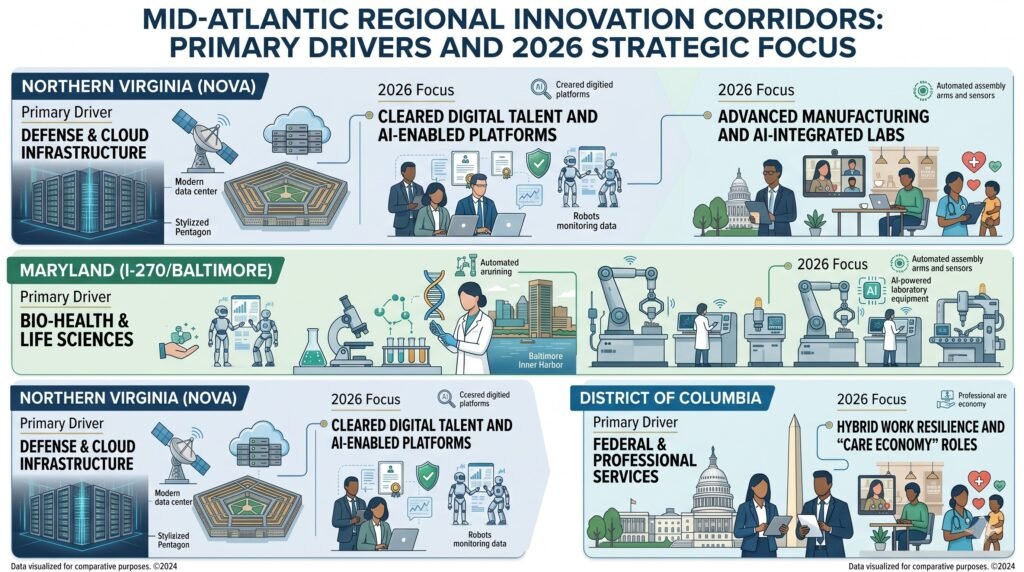
IV. Corridor Intelligence: A Geographic Breakdown
To master the Mid-Atlantic workforce, one must understand the distinct needs of each geographic corridor:
V. Institutional Action Plan: The Mid-Atlantic Workforce Strategy 2026
For regional leaders, the window to address these labor shifts is narrowing. The MPR Editorial Board recommends a three-pronged approach to institutional growth:
- Redesign Recruitment Strategies: Move away from reactive job posting toward proactive talent mappin identifying professionals with relevant clearances and skills months before a vacancy arises.
- Accelerate Hiring Timelines: Align recruitment with modern procurement speeds. The goal should be contracting modular upgrades and rapid commercial talent within months, not years.
- Invest in Governance over Programs: Success in 2026 depends on strong labor-management collaboration and ethical AI guardrails to ensure technology improves job quality rather than causing displacement
VI. Case Studies in Regional Transformation
To understand the practical application of 2026 workforce strategy, we must examine current institutional shifts across the region’s primary economic engines. These cases highlight the “Dual-Track” nature of our current economy.
Case Study A: The Digital Pivot in Northern Virginia (NoVa)
A leading defense contractor in the NoVa corridor faced a critical shortage of “Cleared AI Talent” in early 2025. Rather than continuing a high-friction external recruitment campaign, the institution implemented an “Internal Talent Marketplace.”
- The Strategy: Utilizing a predictive analytics engine to identify employees in legacy IT roles whose skills overlapped by 60% with emerging AI requirements.
- The Outcome: Within 12 months, the firm successfully reskilled 400 internal staff members, reducing their external hiring cost by 22% and maintaining project continuity for critical federal mandates.
Case Study B: Life Sciences Upskilling in Maryland’s I-270 Corridor
A mid-sized biotechnology firm in Rockville utilized Maryland’s $4 million AI workforce grant to integrate “Bio-Informatic agents” into their research labs.
- The Strategy: The firm shifted from hiring general lab technicians to “Augmented Researchers” who could use AI tools to accelerate drug discovery cycles.
- The Outcome: By prioritizing “Skills-First” hiring over traditional credentials, the firm filled 15 specialized roles in half the industry-standard time, directly impacting their time-to-market for new therapeutics.
Request an Institutional Workforce Briefing
The MPR Editorial Board provides bespoke analysis on regional labor trends for C-suite leaders and institutional boards. To request a deep-dive briefing on your specific sector or corridor, please Contact the Editorial Team.
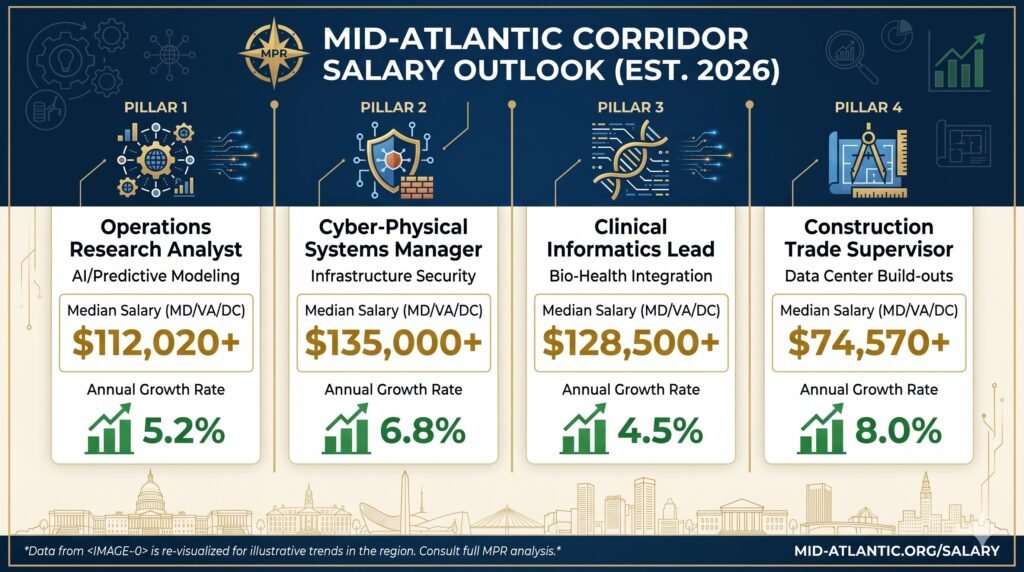
VII. 2026 Salary Benchmarks & Skills Matrix
Institutional resilience requires an accurate understanding of the current market value for specialized labor. Compensation in the Mid-Atlantic is stabilizing globally but remains highly competitive for “Lighthouse” roles.
Regional Salary Matrix: Mid-Atlantic Corridor (Est. 2026)
The “High-Demand” Skill Clusters
In 2026, the most valuable professionals are those who possess “Hybridized Competencies”.
- Technical: LLM Governance, Cloud Infrastructure Design, and Federated Data Systems.
- Cognitive: Strategic Foresight, Complex Problem Solving, and Executive Emotional Intelligence (EQ).
- Institutional: Ethics in AI, Regulatory Compliance Management, and Cross-Functional Leadership.
For ongoing analysis of the Mid-Atlantic labor market, including recent case studies and federal sector updates, explore our Workforce Strategy Commentary Series.
VIII. The Future of Mid-Atlantic Workforce Governance
As we look toward 2030, the governance of the regional labor market will shift from a focus on “programs” to a focus on “connected ecosystems”.
1. Breaking the Academic-Industry Silo
The traditional four-year degree is no longer the sole arbiter of expertise. Institutional leaders must actively participate in “Employer-Driven Curriculum Design” to ensure that the talent being produced by regional universities matches the real-world operational facts of 2026.
2. The Rise of “Joint Decision-Making” Systems
We are moving into an era of “Shared Agency,” where the lines of responsibility between humans and AI agents are blurred. Future-ready leaders must develop frameworks for “Negotiated Autonomy” knowing exactly when to cede control to an AI system and when human oversight is a non-negotiable safety requirement.
3. Scaling Regional Apprenticeships
Governors across Maryland, Virginia, and the District of Columbia have identified the expansion of high-level apprenticeships as the primary economic priority for the late 2020s. These programs provide a low-friction “entry-point” for diverse talent and ensure that regional institutions have a steady supply of workers trained specifically to their internal standards.
The MPR Strategic Outlook In a labor market defined by “Low-Hire, Low-Fire” stability, the organizations that thrive will be those that view their workforce as a dynamic asset to be cultivated rather than a cost to be managed. The Mid-Atlantic corridor is on the cusp of its next great industrial revolution; institutional readiness is the only differentiator that matters.
IX. Navigating the 2026 Regional Regulatory Landscape
For institutional leaders in the “DMV” (DC, Maryland, Virginia) area, compliance is no longer a static checkbox it is a dynamic operational challenge. The 2026 legislative environment is characterized by aggressive wage floor adjustments and new worker protection mandates that vary significantly across state lines.
1. Divergent Wage Mandates
As of 2026, the region has reached a state of “Wage Fragmentation,” requiring complex payroll systems for organizations with distributed workforces.
- Washington D.C.: Effective July 1, 2026, the minimum wage rises to $18.40 per hour, maintaining its position as the highest floor in the region.
- Maryland: Has achieved a universal $15.00 per hour minimum wage for all employers, regardless of size.
- Virginia: Effective January 1, 2026, the state minimum wage increased to $12.77 per hour, reflecting a more incremental but steady upward trajectory.
2. The FAMLI Act and Paid Leave Expansion
Maryland’s Paid Family and Medical Leave Insurance (FAMLI) program enters a critical phase in Fall 2026. Employers must register for the system, which will eventually provide eligible employees with up to 12 weeks of paid leave annually. This mandate requires institutions to redesign their short-term disability and leave-of-absence policies to ensure they integrate seamlessly with state-provided benefits.
3. Restrictive Covenant Reform
The use of non-compete agreements has faced severe restrictions across the corridor. In Washington D.C., non-competes are largely banned for any employee earning less than $162,164 annually, a threshold that forces firms to rely on “Trade Secret” protections and intellectual property agreements rather than traditional employment barriers.
X. Inclusive Infrastructure: DEI as Operational Governance
In 2026, Diversity, Equity, and Inclusion (DEI) have evolved from “optics” to “organizational infrastructure.” High-performing Mid-Atlantic institutions are now integrating these values directly into their decision-making, performance management, and governance frameworks.
1. From Ambition to Accountability
Institutional authority in 2026 is measured by how inclusion is “lived” rather than just stated. Research indicates that organizations that place responsibility for inclusion within the C-suite outperform their peers in productivity and retention. Leadership accountability is now a core capability, with inclusion metrics frequently embedded into executive objectives and succession planning.
2. Psychological Safety as a Performance Enabler
The most resilient regional workforces are those that prioritize Psychological Safety an environment where employees feel empowered to take risks and voice concerns without fear of reprisal. This is no longer seen as a “soft” benefit but as a fundamental leadership responsibility necessary for unlocking innovation in high-stress sectors like defense-tech and healthcare.
3. Navigating the Federal DEI Policy Shift
The 2026 federal landscape, particularly following Executive Order 14398, has introduced new complexities for federal contractors. Contractors are now required to certify that they do not engage in “racially discriminatory DEI activities,” which the order defines as disparate treatment in recruitment or resource allocation. This necessitates a “merit-based” return to DEI initiatives, focusing on individual rights and dignity while maintaining compliance with increasingly stringent federal grant requirements.
XI. Institutional Resilience: The Road to 2030
As we look toward the end of the decade, the Mid-Atlantic workforce will be defined by its ability to weather “Black Swan” events and rapid market pivots.
1. Sustainability and the Net-Zero Agenda
Workplace culture in 2026 is increasingly tied to the Net-Zero agenda. Professionals are gravitating toward institutions with clear carbon management goals and accredited sustainability practices. Training staff in “Green Skills” is now a strategic imperative for organizations seeking to navigate new federal procurement reforms that prioritize eco-conscious suppliers.
2. Flattening Organizational Structures
AI is not only changing how we work but where we work within a hierarchy. Predictions suggest that by the end of 2026, 20% of organizations will use AI to flatten their structures, potentially eliminating significant layers of middle management. This shift requires a new breed of “Agile Leader” who can manage decentralized, high-autonomy teams.
3. The Professional Training Imperative
With 54% of employers reporting worsening skills shortages, continuous professional development is the primary weapon in the war for talent. When employers consistently invest in competency-based qualifications, employees feel more valued and are significantly more likely to remain with the organization.
The MPR Strategic Mandate The Mid-Atlantic corridor is an economic engine built on the strength of its human capital. By aligning institutional governance with the regulatory, cultural, and technological shifts of 2026, leaders can ensure that their organizations do not just survive these changes but lead the next era of regional prosperity.
The Mid-Atlantic Professional Review is an independent strategic initiative hosted by SCBWI-Midatlantic to provide regional economic and workforce intelligence